


The EU-funded project SOLSTICE (May 2024 – November 2027) aims to make the textile industry more sustainable and to promote the transition to a circular economy. The focus is on the so-called 5R strategies: Refuse/Reduce, Reuse, Repair, Repurpose, and Recycling. These approaches are intended to help avoid waste and use resources more efficiently.
Challenges of the Textile Industry
Globally, the textile sector is one of the largest contributors to environmental pollution and greenhouse gas emissions. In Europe, around 26 kg of textiles are purchased per person each year, of which 11 kg are discarded – less than 1% is recycled. Existing collection and recycling systems are inefficient, and consumption patterns are not sustainable.
Pilot Projects in Four Regions
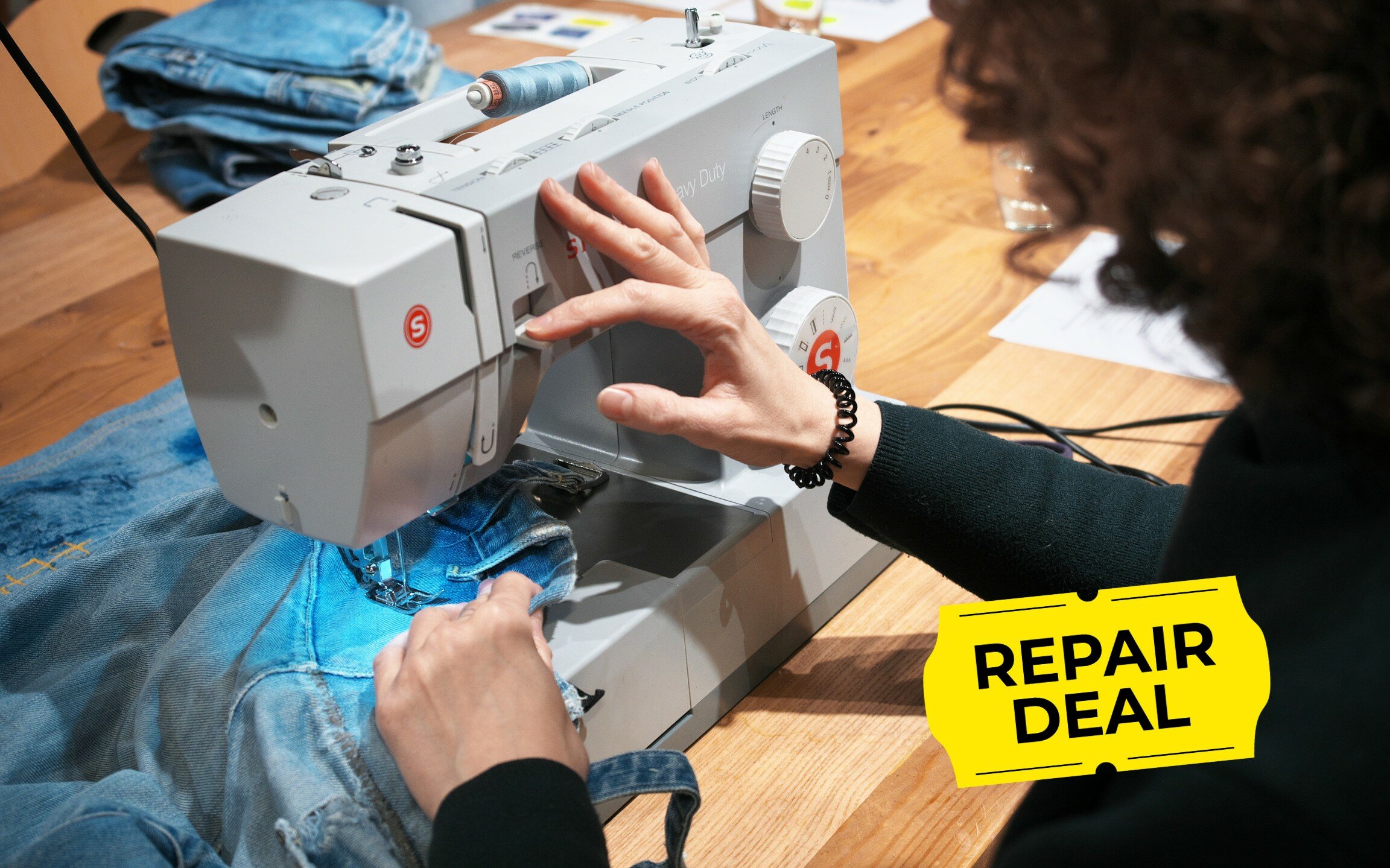
SOLSTICE is testing strategies in Grenoble (France), Prato (Italy), Catalonia (Spain), and Berlin (Germany). As part of a consortium of 24 partners, Circular Berlin analyzes textile flows as well as the business environment and consumer behavior in Berlin. Based on the research findings, a repair bonus system—called the REPAIR DEAL—is being piloted together with FixFirst and local repair experts for denim repairs over a period of 14 months (18 September 2025 – 30 November 2026). The bonus can be easily requested via a digital platform. Customers receive a 50% discount on repairs to their denim jeans.
Innovation and Impact
SOLSTICE is developing four new chemical recycling technologies and promotes collaboration between research, industry, public authorities, and citizens. A digital product passport is intended to improve the traceability of raw materials. The project results are intended to serve as blueprints for other regions and support policy measures such as eco-modulation.
Current Status in Berlin
The pilot project in Berlin has now been running for eight months and is already showing positive feedback. Circular Berlin has successfully engaged 11 tailoring businesses across a total of 14 locations. As a result, it is currently possible in almost all Berlin districts to have jeans repaired at half price. By the end of May, 621 Berlin residents had already applied for a voucher, and around half of them have redeemed the discount at a tailoring shop.
Challenges and Successes
The repair bonus system and its technical infrastructure were developed and continuously optimized over several months. Nevertheless, the day-to-day operations of many tailoring businesses still present challenges. In particular, low levels of digitalization and high workloads make project implementation more difficult.
Despite this, more and more tailoring businesses have joined the sustainable initiative in recent months, and the project’s reach has increased. Together with various partners, Circular Berlin has also organized several REPAIR DAYS, an event series centered around repair. There, Berlin residents could watch their trousers being repaired or get hands-on themselves and learn different techniques to preserve their favorite jeans.