


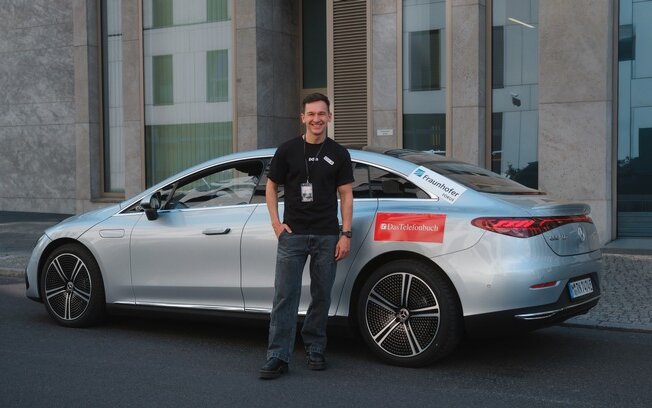
The future of mobility is increasingly shaped by data. Current research projects demonstrate how existing sources of information—such as directory data from “Das Telefonbuch”—can be combined with modern technologies like digital twins of cities and artificial intelligence to sustainably improve traffic safety and efficiency.
What may initially sound unusual is proving to be a promising approach: curated directory data is being made usable for advanced driver assistance systems (ADAS) as part of a research project by pdm solutions and the Fraunhofer Institute for Open Communication Systems FOKUS. At the core is the idea of systematically capturing so-called “points of interest,” such as schools, daycare centers, or playgrounds, and integrating them into modern vehicle systems. These locations are particularly relevant because vulnerable road users are often present there. The integration of this data adds a crucial dimension to conventional navigation systems: contextual awareness.
Core technology: the digital city twin
The foundation of this innovation is the digital city twin—a precise, dynamic representation of the urban road environment. It brings together diverse data sources such as traffic management systems, sensors, vehicle data, and directory information on a single platform. Using artificial intelligence, these heterogeneous data sets can be analyzed, validated, and processed in real time. This enables not only an up-to-date representation of traffic conditions but also forecasts of possible developments, such as congestion or hazardous situations. A key objective is to break down data silos and create an open, sovereign data infrastructure that operates independently of major platform providers.
A concrete outcome of this research is the software SADAS (Support for Advanced Driver Assistance Systems). It uses data from the digital city twin and continuously matches it in real time with a vehicle’s current route and position. If the system detects a potential hazard zone—for example near a school—the driver is warned at an early stage, before the danger is even visible. These warnings can be visual or acoustic and, in the future, may be directly integrated with assistance systems such as automatic braking functions. This creates an “extended horizon of awareness” that goes beyond human perception and significantly improves reaction times.
Data quality as a key challenge
The success of such systems depends critically on data quality. While a correct address may be sufficient for directory services, driver assistance systems require highly precise geocoordinates. Particular challenges arise, for example, in large areas such as school campuses that span multiple streets. Imprecise data could lead to false warnings and, in the long term, undermine acceptance of the systems. To ensure data quality, multiple sources are combined, including stationary sensors, vehicle data, traffic management systems, and even crowdsourced information from smartphone apps.
The results achieved so far are promising. The developed prototype demonstrates that data-driven approaches can provide real added value for road safety. In the long term, digital city twins are expected not only to enhance driver assistance systems but also to serve as a foundation for automated and autonomous driving. In addition, new applications are emerging—from accessible navigation services and intelligent route planning to personalized mobility solutions.